





Australia is one big, glorious island with almost every terrain imaginable, and getting around it can be a hell of a lot of fun. But what comes with endless weekends on the trails and in the outback are sometimes some sticky situations that can turn serious if you don’t have the right gear to get you out of trouble.
Long distances between stops, limited phone reception and an abundance of native wildlife at dusk and dawn are just some of the realities you’ll face on almost every 4WD trip across this great country. Whether you’re hitting the beach, the high country, or getting down and dirty with some desert touring, we’ve put together this comprehensive guide to the 12 must-have 4WD accessories for your next adventure. We cover everything from on and off-road recovery tools, to safety gear, power supply, communication and navigation.
1. LED Driving Lights Upgrade
On long stretches of highway or unexplored off-road trails, when it comes to spotting hazards and changing road conditions, a few seconds’ difference can save lives. Having a powerful set of LED driving lights means you can see further into the night, and your reaction time will be significantly enhanced.
For most Aussie 4WDs, an LED lighting upgrade means spotting wildlife that can appear at almost any moment, seeing into the distance on long, unlit roads, and cutting through dust and rain with ease.
Spotlights
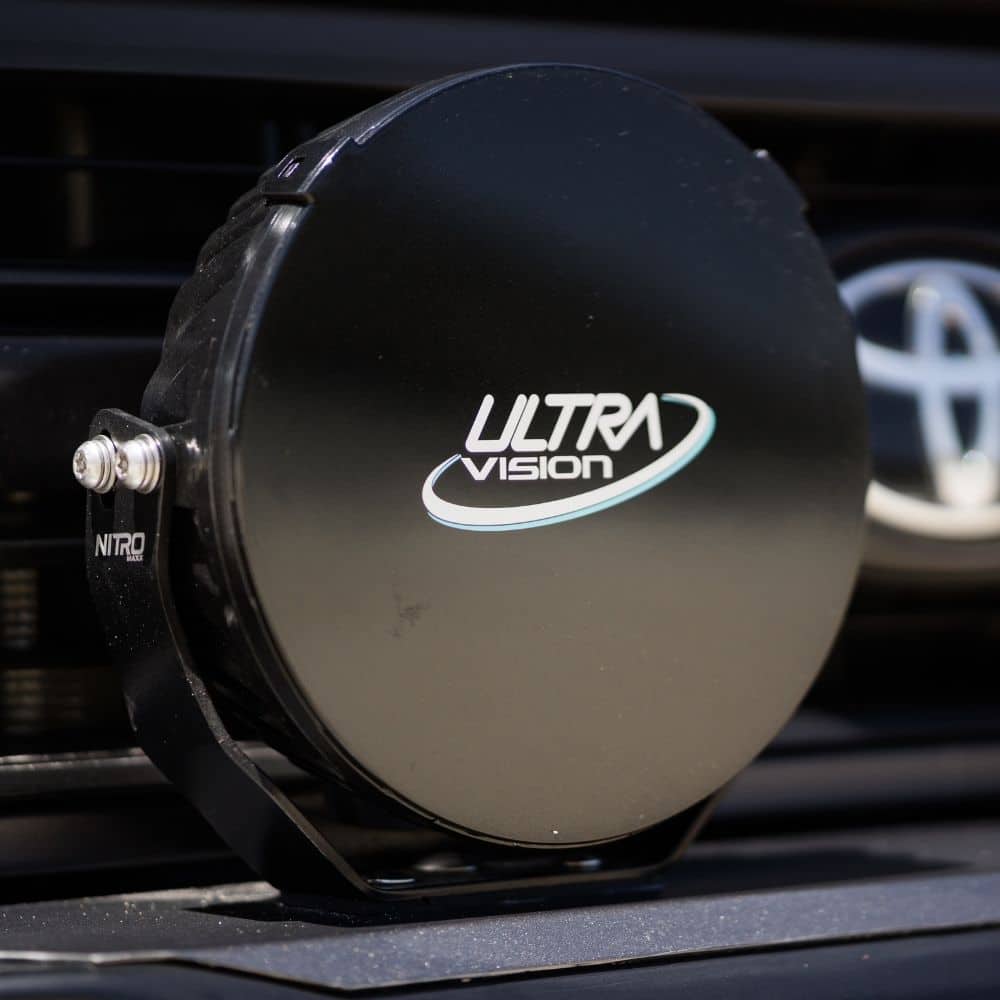
Ideal for highways, fast tracks, and desert driving, where you need a long-distance, focused beam. Our Nitro Maxx 180, Nitro Maxx 140, and Raptor 120 are built for exactly this.

Light bars
Designed to throw a wide arc of light across bush tracks at lower speeds, covering your peripheral vision where wildlife is most likely to emerge. Check out our Raptor 60, Raptor 90, and Nitro 155W light bars for this style of driving.
Combo lights
The go-to for touring, delivering the best of both worlds with spot and flood in a single unit. Our Raptor 120, Raptor 180, and Nitro 220W light bars are our most popular options for all-round touring. They’ll even make those late-night camp setups a whole lot easier.
Not only are Ultra Vision lights powerful, but they’re custom-built for the Aussie outback, meaning they’re built to handle vibrations from unsealed roads and, with an IP68 waterproof and dustproof rating, they’re ready for whatever the track throws at them.
2. 4WD Recovery Kit Essentials
Getting onto the many trails and tracks across Australia is the easy part. Getting out of them can sometimes be a whole different story. Even driving on local beaches and so-called ‘easy’ tracks can present obstacles, especially after rain, when you’re more likely to find yourself bogged in soft sand, clay, or mud.
To get yourself out safely, make sure your 4WD is stocked with recovery kit basics. At a minimum, your kit should include: a snatch strap, shackles, a bridle, a dampener, and a shovel.
3. Recovery Boards (Traction Boards)
One of the most essential accessories to any 4WD trip should be a functional set of recovery or traction boards in good working condition. Recovery boards are the quickest self-recovery tool because they provide an instant solution when you lose traction on the trail. If you’re travelling alone, they’re ideal because they don’t require a power source or a second vehicle to function.
Not just for getting out of bogs, recovery boards can be used as ramps, to bridge ruts before you lose traction, and even for levelling a campsite. When picking out recovery boards for your 4WD, make sure you get the right length (large, heavy-duty vehicles will want at least 1,190mm) and ensure you’ve got an easily accessible spot to mount them, because you’ll want them within arm’s reach on every trip.
4. Winch
Much like recovery boards, when you’re travelling solo you want to make sure you have the right tools to get you through the track. A powerful and reliable winch is a must-have. Practical and not for rookies, a winch is a wise choice for getting you up steep climbs, washed-out roads and trails, and those deep, muddy ruts in the high country, especially on popular trails that have seen a lot of visitors.
When choosing a winch, make sure it has the right rated capacity for your vehicle’s weight. Always use a tree trunk protector when attaching to a tree, and keep a dampener over the centre of the line to reduce risk in case of cable breakage.
We strongly recommend practising your winch technique at home before you head out. Operate in 30–60 second intervals to avoid overheating, and if there are any spectators nearby, keep them at least twice the cable length away. A snapped cable can be seriously dangerous.
5. All-Terrain LT-Rated Tyres
Where the rubber meets the road is literally the most important factor of your 4WD off-roading adventure and the most essential place to ensure you’ve got the right upgrades sorted. For touring vehicles, All-Terrain LT-rated tyres are basically non-negotiable.
LT (light truck) rated tyres are engineered to handle heavier loads and rougher terrain, providing your 4WD with superior stability when you’re off the bitumen. They feature tougher sidewall layers, which provide better resistance to punctures and help your vehicle maintain control by keeping the tyre shape and grip.
Aussie roads and trails are full of nasty surprises: gibber stones, sharp shale, and corrugated sections that’ll rattle your teeth. Having the right rubber underneath you is non-negotiable.
6. Air Compressor + Tyre Deflator/ Gauge
Anyone who has ever taken on some serious sand dunes or taken their rig down to the beach knows that having the right tyre pressure is the difference between making it back in one piece and spending the afternoon stuck in the sand.
For sandy driving, you want a lower tyre pressure so your tyre has more surface area and greater traction on soft ground. An air compressor is a must-have for reinflating before you hit the road again. When choosing an air compressor for your 4WD, pay close attention to flow rate, duty cycle, and hose length. These are the three key specs that’ll determine how well it suits your setup and how quickly it gets the job done.
7. Tyre Repair Kit + Full-Size Spare
On the thousands and thousands of kilometres of Aussie roads, you can go hours (or almost days) without seeing another vehicle. When it comes to repairing a puncture, you definitely want to have the tools to at least get yourself moving, even if it’s just long enough to reach a proper fix.
Tyre repair kits come in all shapes and sizes, but the most valuable thing in your arsenal is a full-sized spare tyre, inflated and in good working order. You might be tempted to forgo a spare and save space, but trust us, a spare tyre is the difference between a slow drive to help and sitting in one spot waiting for help to come to you, which in remote Australia could mean a very long wait indeed.
8. UHF CB Radio
We can sometimes forget that not every square metre of Australia is covered with mobile phone reception. While 99% of our population lives within mobile coverage, the reality is that only a fraction of the actual land mass is covered, and when you’re deep in the outback, that gap becomes very real, very quickly.
27% of Australia’s land mass has mobile phone coverage. That leaves 73% of the country where your phone is essentially a fancy paperweight. A UHF CB radio is your most reliable fallback.
A UHF radio enables you to alert your convoy to upcoming hazards and, in the worst-case scenario, call for help. You can choose between a handheld unit or a fixed-mounted radio depending on your setup. Just make sure you’re familiar with the rules and etiquette of radio communication before you’re on the air (the ACMA has a useful guide to CB radio in Australia).
10. Dual Battery System or Portable Lithium Power Station
These days, more and more accessories need power on the road during long journeys, whether it’s fridges, communication equipment, lighting, or recovery gear. Having enough juice to get the job done is critical for a successful 4WD trip.
The traditional go-to has been a dual-battery setup, which adds a second battery to your vehicle, usually to run 12V accessories without risking your starter battery. It’s a tried-and-tested solution that’s worked well for Aussie 4WDers for decades.
In recent years, though, there’s been a growing shift toward portable lithium power stations. Similar in concept to a large phone charger, these units can be charged at home via mains power or on the road via solar panels, and they come with all the common connections you’d need: 12V outlets, USB ports, and even 240V AC outputs. They’re particularly popular with campers who want flexibility without the cost of a full dual-battery install.
12. First Aid Kit
Not to be dramatic, but there are a whole bunch of things in the Australian outback that (if they aren’t going to seriously injure you) will definitely do some damage. To keep you and your travel companions safe on every journey, a fully stocked first aid kit is an absolute must… and we mean fully stocked! A couple of band-aids isn’t going to cut it out there.
If you’re heading off-road and run into an emergency, a medical response could be hours or even days away. In conditions like extreme heat and dehydration, minor cuts and small medical issues can quickly escalate into something much more serious.
At a minimum, your off-road first aid kit should include snakebite bandages, wound care supplies, pain relief, an emergency thermal blanket, and a written emergency plan. We also recommend completing a wilderness first aid short course before heading into remote areas. St John Ambulance Australia runs courses specifically designed for remote and outdoor situations that are well worth doing before your next big trip. It’s a few hours that could genuinely save a life, yours or someone else’s.
13. Storage and Load Management
There’s one universal truth about 4WD trips: no matter how carefully you pack, you will always have more stuff than you thought possible. Especially if you’re planning to camp along the way, your 4WD will fill up quickly with all the accessories and tools you need to get there and back safely.
Properly securing all of that gear is not just about staying organised. It’s a genuine safety issue. On rough, corrugated tracks, loose gear can quickly become dangerous projectiles inside your vehicle. Drawers, roof racks, and tub systems are the smart solution, giving everything a fixed home.
When packing, follow the golden rule: heavy items go low, and frequently used items, like your first aid kit and recovery gear, stay within easy reach. Use anchor points and rated tie-down straps to secure everything that could shift on the trail.
Final Word
Whether you’re heading off-road for weeks at a time or simply hitting the highway in search of the perfect weekend adventure, the right gear can mean the difference between an epic trip and a dangerous situation. Run through this list before every trip, and make sure everything is tested, charged, and ready to go before you leave the driveway.
And if there’s one upgrade you make before your next trip, make it the lighting. A powerful set of Ultra Vision LED driving lights is the single most impactful safety modification you can make to any 4WD; giving you more reaction time, better visibility, and the confidence to keep moving when the sun goes down.
